
blog

Susanna Coffey Speaks at the MET June 21st 6:30-7:30pm

June 12, 2013

Metropolitan Museum of Art

Artists on Artworks     Susanna Coffey

Friday, June 21, 6:30–7:30 p.m.

Free with Museum admission, though tickets are required

Comments (0)

Susanna Coffey on Huffingtonpost Image Blog

April 13, 2013

Click here to see website

Comments (0)

THE ANNUAL: 2013

January 30, 2013

National Academy Museum / January 31 – May 5

1083 5th Ave at 89th Street New York, NY 10128

Susanna Coffey will be exhibiting at The Annual: 2013, a tradition at the Academy since its founding in 1826, the exhibition includes work by recently elected Academy members and highlights their important contribution to American culture.

Comments (0)

NYSS Benefit Auction and Dinner

October 09, 2011

Susanna Coffey has donated a piece for the New York Studio School Benefit Auction and Dinner

November 1, 2011
 / 6:00 PM Cocktail Reception and Silent Auction
 / 8:30 PM Dinner

For further details please click here

Comments (0)

New Bedford Museum – February 9 through May 22, 2011

February 11, 2011

When Joan Backes, the Curator of Vault Series at The New Bedford Museum contacted me about exhibiting my paintings there, I was very interested in doing so. Your city has long held an important place in my imagination. New Bedford in the 1840′s was home to two of America’s most influential artists, the writer Herman Melville and the painter Albert Pinkham Ryder. Both are known for works that reveal a human consciousness that is inextricably merged with the “natural” world. According to this Transcendentalist vision each of us is bound in ongoing and dynamic interchange with the surrounding earth, water and air. I am one of many artists whose work is deeply influenced by this way of seeing, by these two sons of New Bedford. As a painter, Ryder has been an early and consistent source of inspiration. The powerful abstractness of his figurative paintings shows me that a “realistic” image is not enough.

One must see how an image is placed on the rectangle of the canvas and how the paint itself appears in order to fully access an authentic iteration of that image. Melville, the writer challenged me to look closely and hard at the world and it’s creatures. His ability to impart his perceptions in a clear and accessible language challenged me to do the same. More than anything, reading Melville has helped me throughout those many “dark drizzly Novembers in my soul” that are familiar to any mature artist. I am so pleased to be a part of this exhibition series.

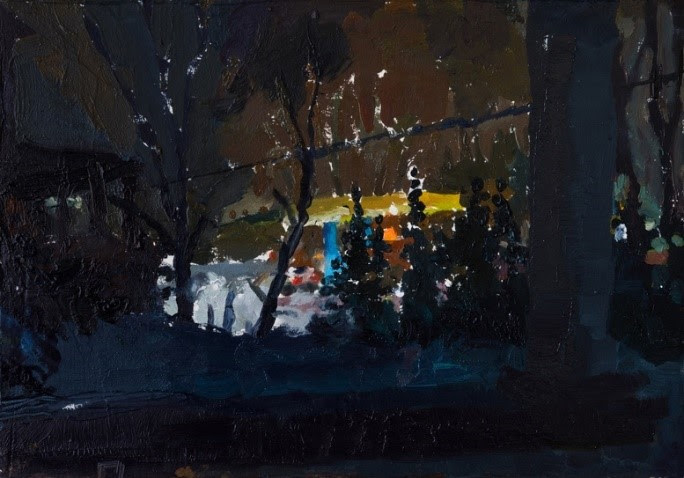
A few words about the paintings in this exhibition: While the portraits are focused on individual faces, the landscape elements that surround the figure provide essential clues about her or his interiority. Without clouds or foliage, without a specific proportion of figure to ground, without a sense of light or dark, there could be no feeling to these figures. The night paintings also seek to evoke not only the appearance of a place but also the way it can feel to see in the dark, to be alone in it looking at the colors of night. The flower paintings are detailed and intimate arrangements of a single species. These careful arrangements of wild plants are meant to suggest a “letter from the world”, a moment of formalized nature. Although the blossoms are cut and becoming dry, these paintings preserve something of their last vivid coloration and patterning.

Comments (0)

The Unbeautiful

December 26, 2010

There are many ways to speak about the past. Within the world of visual art, the past is a place as vital as the present. Artists who no longer walk in this world are none the less among the living in the form of their Art. For many of us here there are artists without whom our own work would not be possible. The ones who showed us ways that we could and would and knew we should follow. For me two such artists are Leon Golub and Nancy Spero who have recently passed from us. I was introduced to their work when I was a student in the 70’s, their influence freed me to pursue what was then a most unfashionable approach to art-making: narrative, figurative painting. Since then I have seen the influence of their work upon decades of emerging artists.

Even after the many deaths of painting, there will always those who feel that although the lark is on the wing, the air is foul, that the snail may not be able to find a living thorn, so God may be in his heaven but all is certainly not right with the world. And strangely enough that ancient and ongoing practice of painting the storied, unright world has continued to  provoke the imagination of the young artist. Leon and Nancy brought historic, painted imagery into their art, art which addresses our ancient and ongoing human capacity to destroy, hate and harm. This short presentation is a brief thanks to them and those artists who desire a more beautiful human context, who would unblind us to our dystopias by the beauty of their works.

The Unbeautiful Painted Narrative, Dystopian Content in Contemporary Figurative Painting: A Legacy of Leon Golub and Nancy Spero |  Adrienne Rich, “Poetry and Commitment”   | Publisher: Norton, W. W. & Company, Inc. April 2007

“Whatever is unnamed, undepicted in images, whatever is omitted from biography, censored in collections of letters, whatever is misnamed as something else, made difficult-to-come-by, whatever is buried in the memory by the collapse of meaning under an inadequate or lying language — this will become, not merely unspoken, but unspeakable.” Adrienne Rich*

The art scene of the early 70’s in the US was a diverse and vital one. Minimalism, performance art, installation and what is now called conceptual art were all strong voices within in the cultural context of that time. It was also during those years that figurative painting, long dismissed by critics, curators, and gallerists, began to receive quite a bit of attention in the art world. The work of artists such as, Chuck Close, William Bailey, Rackstraw Downes, Janet Fish, Alex Katz, Alice Neel , Philip Pearlstein, Wayne Thibeault, Nancy Spero and Leon Golub became widely recognized.

 These artists drew upon the long history of figure painting and sought to create work that had currency and was not nostalgic. Their visibility offered to subsequent generations the possibility of working within a traditional practice while expressing a sense of the contemporary. Artists like, Katz, Neel and Pearlstein used images that could signify their time they were (i.e., cars, clothing, hair styles, furniture, etc.). Others like Downes, Fish and Flack reinvestigated other figurative traditions like landscape and still life. Most in this group were after coolness and neutrality in regards to content as well as form. Golub and Nancy Spero, (both SAIC, 1949-50, grads) took a different approach to the history of figuration, that of the content laden narrative.

While many painters sought to avoid expressionistic story telling, it was just that that Golub and Spero were seeking to image. They brought figurative, narrative painting to bear on issues concerning the public sphere. Both of their oeuvres invoke a powerful sense of human failure. Atrocity, oppression melancholy, loss and despair all are to be felt in these works. The visuality of this art, on the other hand, is of a great painterly beauty. Both artists expressed a desire to image human wrongs in a way that could stimulate a sense of empathy and awareness of what could be right. They brought forward from the long history of painting a juxtaposition of the beautiful image with the negative or horrible as content. It seems to me that this direction, the one that was rather an exception at that time has proven to be perhaps the most influential. Now, similarly, painters who are drawn to  figuration and the figurative narrative are often expressing feelings and ideas about the problematic within our contemporary public context, the dystopia in which we may be seen to live. These two artists are often referenced as important forces in the development of art that is being made now. I will now make brief reference to a few artists working and showing now who have acknowledged the influence of Golub and Spero and whose work addresses something that has gone wrong and seems to be staying there.

 Contemporary artists such as, Abigail DeVille, Jaime Henderson, Khalif Kelly, Steve Locke, Steve Mumford, Juan Perdiguero, Judy Raphael, Denyse Thomasos, Maria Vergara, and Bernard Williams create works which are gorgeous and arresting but also show us a more difficult, less lovely picture of our social sphere.

The Installation “What Happens to a Dream Deferred”, Abigail De Ville is composed of visual elements observed in her South Bronx neighbor hood. She deals with the imaging the kind of  the well marketed hip hop persona that expresses energy and agency but also with misogeny and homophobia. 

(images coming soon to accompany this text)

 Jaime Henderson’s large drawings appear at first glace to be light and playful pictures of young conventionally pretty women at play. However at close look we see these girls are not so nice and their play is a tragedy rather that a comedy.

  Khalif Kelly’s beautiful and vivid paintings of children at play also seem at first playful and cheerful but a closer look reveal a childhood where cruelty, rascism and isolation are the norm. His protagonist seems puzzled by the unkindness of his companions

 Steve Locke’s figurative works, paintings prints installations and mail pieces all picture a gay maleness that is so seldom present in figurative painting. T

 The subject of Judith Raphael’s paintings and large wall installations is the intense aggression that commonly takes place between young girls but is seldom acknowledged by society. She equips each girl with a body position taken from the Roman sculptures of military heroes. And with this choreography the girls exhibit a violence upon each other that is fierce and serious. 

 Steve Mumford creates a very direct and personally informed take on the military and on war in his paintings and drawings made during and after his time as an imbedded artist in Iraq. The works are clear direct and intense.

 Juan Perdiguero’s huge printed and painted wall installations construct a space where the domestic animal, a dog becomes rampant and threatening, overwhelming the presence of the viewer and reminding us perhaps of our own potential for violence. 

 Denyse Thomasos, in her energetic and abstracted wall installations and paintings references dystopian spaces and structures. The work often begins with orderly building plans for such places as; cities, prisons, slave ships The works concludes in in the beautiful destruction of that order. 

 The playful aspect of Maria Vergara’s work begins with the not so playful cult of celebrity. A cult  that seems to be in control of our public imagination today. She twists and turns the painted Queens, Princesses, heiresses and movie stars until they and the worlds they inhabit look as grotesque as they really are. 

The intense and dense paintings of Bernard Williams combine words, images and symbols to refigure and retell usual historic events in ways that are truthtelling. They create textured colorful  and iconically overloaded reply to that lie that official history often is. Pictures such as “America was Mexican” and “Charting America” retell, fill in, re-evoke the results and force of such lies.

–Susanna Coffey

Comments (0) | Tags: , ,

Painting as an act of resistance

“I’ve always been interested in representations of the feminine within the history of painting. Its history is something that interests me for many reasons. You might say that painting is a signifier for beauty iself, and the realm of the aesthetic. The subject of “feminine appearance” has also to do with categories of beauty and aesthetics. So I feel like these two things – painting and representations of women – are important to one another, and for me are worthy of a lifetime’s investigation. And it’s particularly interesting to me to be doing it as a woman when painting has been declared dead. As an act of resistance, I’m very interested in being a painter.”

Susanna Coffey Reprinted from an interview with Michael Rooks, in exhibition catalogue for Susanna Coffey: New York, Tibor De Nagy Gallery, 2001

Comments (0)